ITSSOSO Journal
What Is Signal-First Local Discovery?
A plain-language explanation of the signal-first model behind ITSSOSO.
Key takeaways
- Signal-first local discovery shows what is active, not only what exists.
- Permanent business and place profiles remain the foundation of local discovery.
- Signals add current offers, events, availability, marketplace activity, and timely updates.
- Timing, location, freshness, and context help people make faster local decisions.
- Expired or inactive information should stop leading active discovery.
Quick Answer
Local discovery should show what is active—not only what exists.
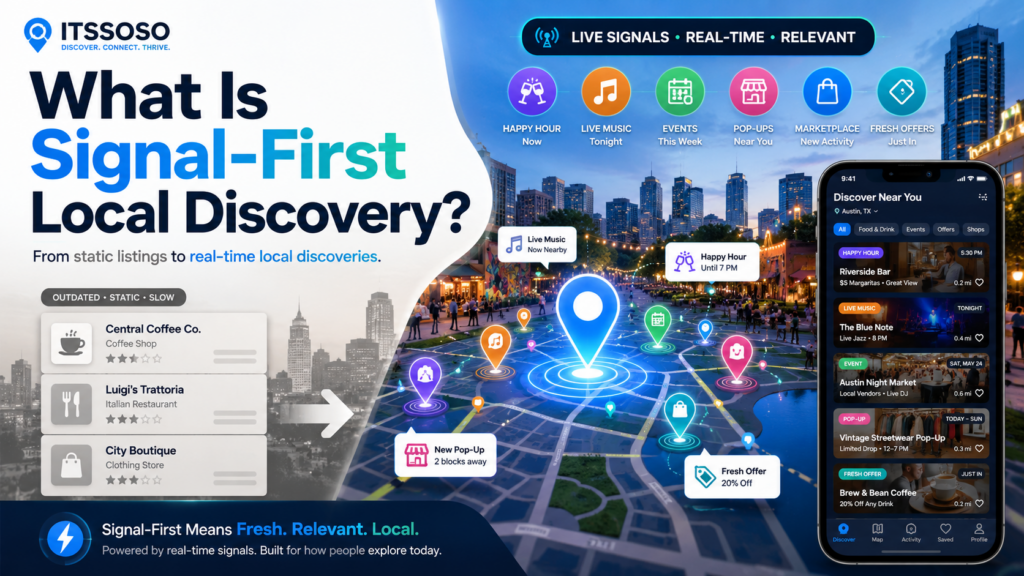
Signal-first local discovery organizes discovery around fresh activity. Instead of only showing who exists in a city, it helps people see what is happening, available, nearby, and worth acting on right now.
A signal can be an offer, event, pop-up, availability update, marketplace listing, new product, experience, recurring activity, or local announcement. It turns passive information into active context.
This approach helps people answer practical questions such as: What is happening tonight? Which businesses have something new? What is still available? Where can I find a nearby market, event, special, or experience?
From Static Listings to Live Local Signals
📇
Static Listing
A static listing explains that a business or place exists. It usually includes a name, address, phone number, hours, and basic description.
- Useful for basic research
- Often changes slowly
- May become outdated
- Does not always explain why to visit now
⚡
Live Signal
A live signal explains what is active, timely, available, or changing. It gives people a current reason to visit, explore, attend, buy, or participate.
- Built around timing and relevance
- Connected to real locations
- Updated as activity changes
- Helps people make faster decisions
Why Signal-First Local Discovery Matters
Local decisions are rarely abstract. People want to know where to go, what is active, what is still available, what is happening nearby, and whether a business has a current reason to visit.
Traditional profiles are still important, but profiles alone cannot always answer questions about what is happening tonight, this weekend, or during the next few hours. That is why signal-first local discovery belongs inside ITSSOSO’s larger live city discovery model.
A listing answers, “What is this place?” A signal answers, “What is happening here, and why should I care about it today?”
The Problem This Solves
Many local platforms organize information around static profiles. That helps with basic research, but it does not always help a person decide what to do tonight, where to go this weekend, or which opportunity is still active.
🕒
Missing Timing
A profile may identify a place without explaining what is available today or during a specific time window.
🔄
Stale Information
Old offers, expired events, and unavailable marketplace items reduce trust and create frustrating experiences.
🧭
Weak Discovery
People may know what exists without understanding what is relevant to their location, interests, or immediate plans.
What Can Become a Signal?
🍹
Offers
Happy hours, daily specials, limited-time promotions, discounts, and new menu items.
🎟️
Events
Live music, comedy, classes, festivals, markets, community gatherings, and recurring activities.
🛍️
Marketplace
Active products, vendor activity, pop-up sellers, local goods, market days, and availability updates.
🎪
Pop-Ups
Temporary shops, food vendors, mobile businesses, seasonal concepts, and limited-location appearances.
🎵
Experiences
Live entertainment, tours, tastings, classes, activities, performances, and things people can do locally.
📣
Updates
New products, changed hours, newly available services, local announcements, and current availability.
How ITSSOSO Makes This More Useful
ITSSOSO uses signals to bring timing, location, category, freshness, and action into the discovery experience. Each signal can connect to a permanent place, business, marketplace venue, district, or event location.
01
Connect the Activity
Signals connect offers, events, marketplace activity, and experiences to real businesses and places.
02
Add Time and Place
Timing, geography, district, category, and availability make each signal easier to understand.
03
Make It Actionable
People can move directly from discovery into a business, event, marketplace item, map, or live activity.
04
Protect Freshness
Expired events, stale offers, and inactive marketplace posts should stop leading discovery.
05
Support District Discovery
Signals help people understand activity within neighborhoods, districts, cities, and metropolitan areas.
06
Improve Discovery Quality
Fresh, structured activity gives search systems and people clearer information about what is locally relevant.
Key Benefits
- Signals make local activity easier to understand.
- Freshness increases trust.
- Businesses can publish timely updates and offers.
- Customers can make faster local decisions.
- Events, offers, marketplace posts, and places can work together.
- Districts become easier to explore through real activity.
- Expired and inactive information can be removed from active discovery.
- Businesses gain more ways to stay visible between major announcements.
Practical Use Cases
For Residents and Visitors
- Discover live local offers
- Find nearby events
- See what is happening tonight
- Explore a district through current activity
- Find marketplace items while they are active
For Local Businesses
- Promote a slow-day special
- Publish recurring entertainment
- Announce a new product or service
- Share current availability
- Stay visible through fresh activity
For Communities
- Highlight neighborhood events
- Promote farmers markets and swap meets
- Surface cultural and civic activity
- Connect districts through shared movement
- Strengthen local participation
Explore What Is Active Near You
Move from the idea of signal-first discovery into the active ITSSOSO experience.
Where to Go Next on ITSSOSO
Readers can move from this article into active ITSSOSO sections where local discovery, business visibility, events, marketplace activity, and city movement come together.
Discover
Explore fresh activity, recurring experiences, places, and signals throughout the city.
Businesses
Find local businesses and see the offers, events, experiences, and signals connected to them.
Events
Browse upcoming and recurring events, entertainment, classes, festivals, and experiences.
Marketplace
Explore local listings, markets, vendors, swap meets, farmers markets, and available products.
Live Now
See time-sensitive local activity that is happening now or during the current day.
Map
Explore places, signals, events, and marketplace activity through geographic discovery.
Frequently Asked Questions
What counts as a signal?
A signal is a fresh local reason to act, such as an offer, event, update, experience, availability window, marketplace post, pop-up, or announcement.
Why is a signal different from a listing?
A listing describes a place. A signal explains what is happening, when it is happening, and why someone may want to act on it.
Does signal-first discovery replace business profiles?
No. Permanent business and place profiles remain the foundation. Signals add fresh activity, timing, and relevance around those profiles.
Can recurring activity be a signal?
Yes. Recurring offers and business promotions can be signals. Recurring public activities with scheduled attendance may be treated as events, depending on their purpose and structure.
How does freshness improve trust?
Freshness helps people avoid expired offers, unavailable products, canceled events, and outdated information. It makes discovery more dependable.
Why is geography important to signal-first discovery?
Local activity only becomes useful when people can understand where it is happening. Connecting signals to cities, districts, places, and maps improves relevance.
The Bigger ITSSOSO Direction
ITSSOSO is building toward a living city intelligence layer where businesses, offers, events, experiences, marketplace activity, maps, and fresh updates connect through one signal-first discovery system.
The permanent profile establishes what a place is. Events show scheduled public activity. Signals provide timely reasons to act. Marketplace records connect local commerce. Geography organizes everything by metro, city, and district.
Together, those systems turn local content into local movement.
Frequently asked questions
What is signal-first local discovery?
Signal-first local discovery organizes local information around fresh, actionable activity such as offers, events, availability, marketplace activity, and timely updates.
How is a signal different from a business listing?
A business listing describes what a place is, while a signal explains what is happening now and why someone may want to act.
Does signal-first discovery replace business profiles?
No. Permanent business and place profiles remain the foundation, while signals add current activity and relevance.
What can become a local signal?
Offers, specials, product updates, availability, announcements, pop-ups, marketplace activity, and other timely reasons to act can become signals.
Why does freshness matter in local discovery?
Freshness reduces outdated information and helps people trust that offers, events, products, and availability are still active.
Next step
Turn local activity into discoverable movement.
Use ITSSOSO to connect businesses, offers, events, marketplace activity, experiences, and live city signals into one fresher discovery layer.